Hidden timber forms in the Waiheke bush: A reimagined bach
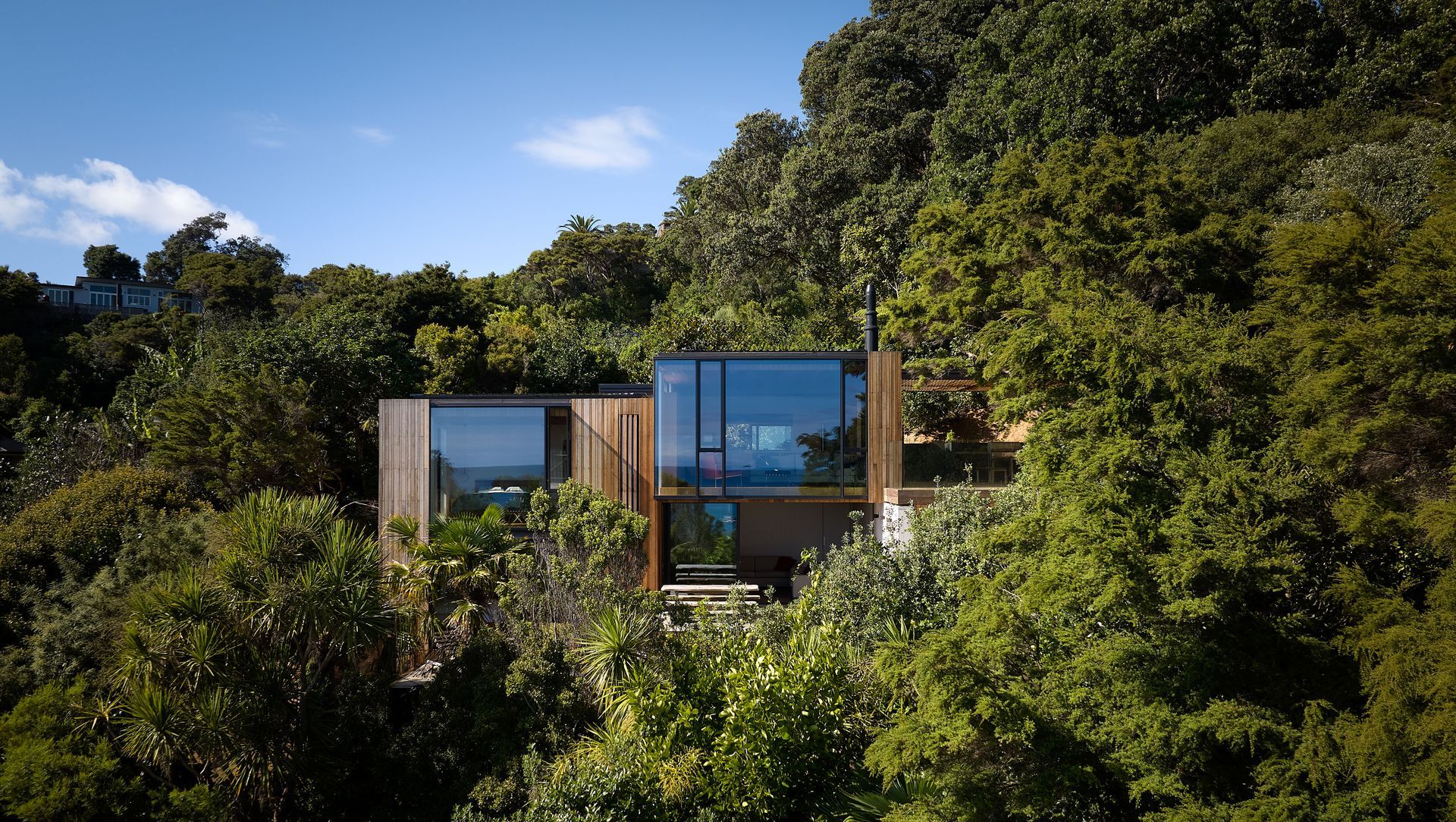
Concealed within dense bush high above the curve of Palm Beach on Waiheke Island, this retreat by Dorrington Atcheson Architects avoids the immediate gratification so often associated with coastal architecture. Instead, it withholds. Arrival is deliberate, quiet and almost cinematic, allowing the landscape to unfold as it’s encountered.
For architect Tim Dorrington, the project carries a personal resonance. “I’ve got quite a long history with Waiheke,” he says. “My family bach was there and it’s where I designed my first house back in 1999.”
The clients had owned an original bach on the site, one that had reached the end of its life. While small in scale, the brief called for something equally restrained in spirit. Rather than creating an expansive holiday home, the intention was to craft a carefully considered retreat that privileged atmosphere, materiality and intimacy over excess.
“The brief was for a house that was humble in size and in its general spaces,” Dorrington explains, “but highly thought through in the detail of the materials and the way everything worked together.”
That familiarity brought with it an instinctive understanding of both the challenges and rewards of building on the island. Tight bush sites, steep contours and difficult access demand careful and considered responses, yet those same constraints often produce Waiheke’s most memorable architecture. Hidden among dense native planting and elevated above the coastline, these homes are deeply connected to the island’s extraordinary beauty.
That sensibility to place is immediately apparent in the home’s composition. Conceived as a series of elemental forms, the architecture reads as both robust and elusive. When first encountering the home, a darkened timber volume hovers above the terrain, offering little indication of what lies within.
“I had this idea of a large timber box that presented literally nothing to the road,” says Dorrington. “As you approached it, I wanted it to give nothing away. You just have this floating timber box hovering above the ground.”
The architecture is organised into three primary elements. A two-storey volume contains the bedrooms and service spaces, while a separate single-level pavilion accommodates the kitchen, living and dining areas. Between them sits a glazed circulation spine anchored by a sculptural spiral stair. Below, carved into the slope, a sheltered media room occupies the undercroft.
Together, these forms step carefully with the topography, allowing the house to transition naturally up the site. The experience of moving through the home becomes one of compression and release, where scale, light and outlook are carefully orchestrated.
Arrival begins from below. Visitors descend the driveway before crossing a small bridge suspended above a natural drainage channel. From underneath the house, the timber volume looms overhead, punctuated only by narrow slots of glazing. A path curves around the structure before revealing a two-storey glazed void containing the staircase.
Inside, the sequence continues to unfold incrementally. Guest bedrooms sit at the lower level, partially concealed behind warm timber linings and integrated joinery. A series of short stair runs gradually lift occupants through the house, each shift in elevation offering another subtle change in perspective.
“You don’t really see the view until you get into the rooms,” Dorrington says. “Until that moment, you feel like you’re in much more of a bush treehouse.”
It is this choreography of concealment and revelation that gives the project much of its emotional depth. While the beach sits directly ahead, the architecture intentionally resists framing it too early. Instead, the surrounding bush becomes the dominant experience, immersing occupants within the landscape before finally opening outward to the distant sea.
The material palette reinforces this sense of retreat. Externally, cedar cladding wraps the forms in a muted, textural skin that will continue to silver over time. Detailing is precise yet understated, allowing junctions, parapets and openings to feel quietly resolved rather than overtly expressed.
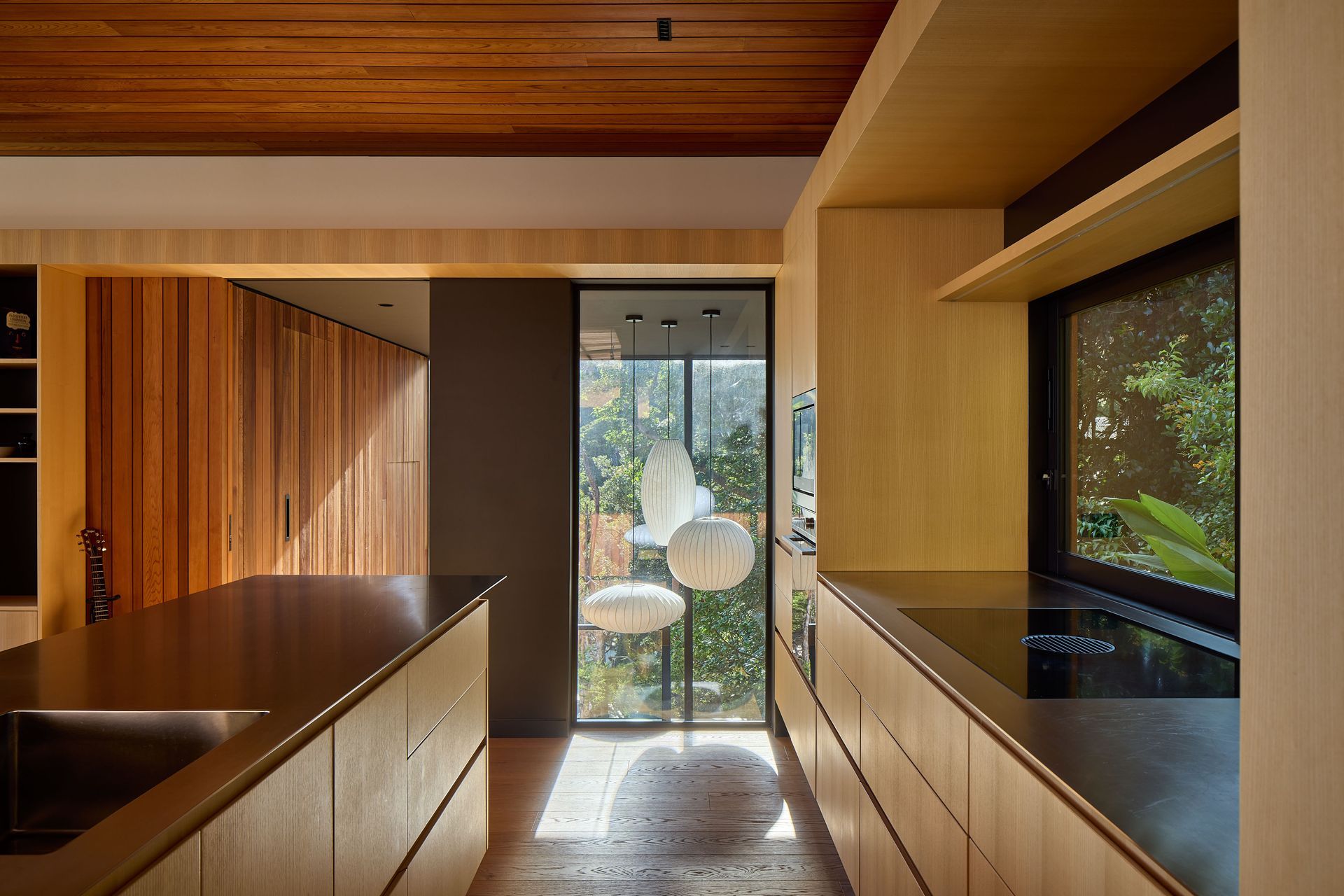
Inside, the same cedar linings continue across walls and ceilings, blurring the boundary between interior and exterior. White grooved timber joinery conceals storage, laundry spaces and bathrooms behind flush integrated panels, contributing to the home’s calm and highly edited atmosphere.
“There are a lot of built-in elements and linings,” says Dorrington. “The white grooved timber lining continues from the courtyard outside into the media room, then wraps around the room itself, so it becomes one continuous element.”
Warm timber flooring and carefully crafted shelving soften the architecture further, lending the interiors a tactile richness that feels deeply connected to the surrounding landscape. Throughout, there is an emphasis on simplicity and continuity rather than visual noise.
The living pavilion is perhaps the project’s most compelling space. Elevated toward the view, it opens in two directions, one toward an outdoor room and the other toward the distant waterline beyond Palm Beach.
“I love the lounge room,” Dorrington reflects. “Those two big doors slide open completely and it really does work as one space with the outdoor area. It tunnels your view out toward the landscape.”
Yet despite the openness, the house retains an unexpected sense of shelter. Deep within the trees, protected from wind and weather, it becomes as much a refuge during storms as it is a summer beach house.
According to Dorrington, the clients have embraced precisely that duality. “It’s become everything they were looking for,” he says. “It’s a retreat. They spend time reading books, hanging out, and having friends over. It’s also a really nice place to be when it’s raining.”
What ultimately distinguishes the project is not scale or spectacle, but restraint. The architecture relies on subtle sequencing, proportion and material consistency to create atmosphere. Every transition has been carefully calibrated, and every detail resolved.
“It’s a very simple composition,” Dorrington says. “Three boxes, really, two timber boxes and a void. But the detailing has to be built perfectly to make that simplicity work.”
As more homeowners seek spaces that respond thoughtfully to both landscape and lifestyle, projects like this reflect a growing emphasis on homes that are deeply personal, highly functional and built to evolve over time. Platforms such as ArchiPro continue to play an important role in connecting architects, clients and industry professionals, bringing together the projects, products and expertise that help turn ambitious residential visions into reality.