

Located in North Sydney, the duality of this Thomas House façade offers a preamble to a respectful alteration and addition that bridges the cottage’s architectural past with the contemporary comforts of multi‑generational living. This dialogue between the meticulously preserved Gothic architecture and the inconspicuous modern extension that spills onto the adjacent site reinstates the streetscape’s integrity with quiet precision.
When the project commenced, Architect Edward Dieppe of Dieppe Design explains, the heritage-listed carpenter cottage – a near-twin reflection of the neighbouring residence at lot 28 – was in a state of serious disrepair. “The original timber joinery had been replaced with aluminium and there was a very unsympathetic, boxy extension at the back,” Ed notes, recalling a closed-off structure that failed to capitalise on scenic views of Berry’s Bay.
And while lot 26 offered an opportunity for respectful resurrection, vacant lot 24 presented as a narrow yet blank architectural slate, setting the stage for what Ed humorously refers to as “filling in the missing tooth” – an infill development that observes the heritage rhythm of the street while maximising an abundance of space rare this close to the centre of North Sydney.
CHALLENGE
This ambitious brief – a comfortable family home for seven people across three generations on a compact, heritage‑bound site – came with a set of unique challenges.
To ensure the home had enough space for the multi-generational family and provided the necessary separation for the adults, the design required the addition of a semi‑subterranean lower level. Because of a strict Council mandate to restore the dwelling to its original form with meticulous accuracy, this became a demanding engineering challenge – the home’s original timber “skeleton” had to be suspended on a steel frame for several months while the site below was excavated.
In addition to retaining the original fabric, there were strict aesthetic requirements. “We had a DA condition where we could only use single-glazed windows in that part,” Ed says, describing one of the constraints that ultimately hampered the project’s initial hope for Passive House certification – they had to be fabricated in the original way, with traditional cord sashes, which meant they wouldn’t be airtight or as thermally efficient.
To ensure the dwelling remained comfortable, the new addition would have to do the heavy lifting, functioning as a high-performance thermal envelope to balance the limitations of the original cottage.
SOLUTION
Ed’s considered design doesn’t just address the limitations – it rearticulates the home’s heritage charm as the social heart of a carefully zoned, high-performing multigenerational dwelling.
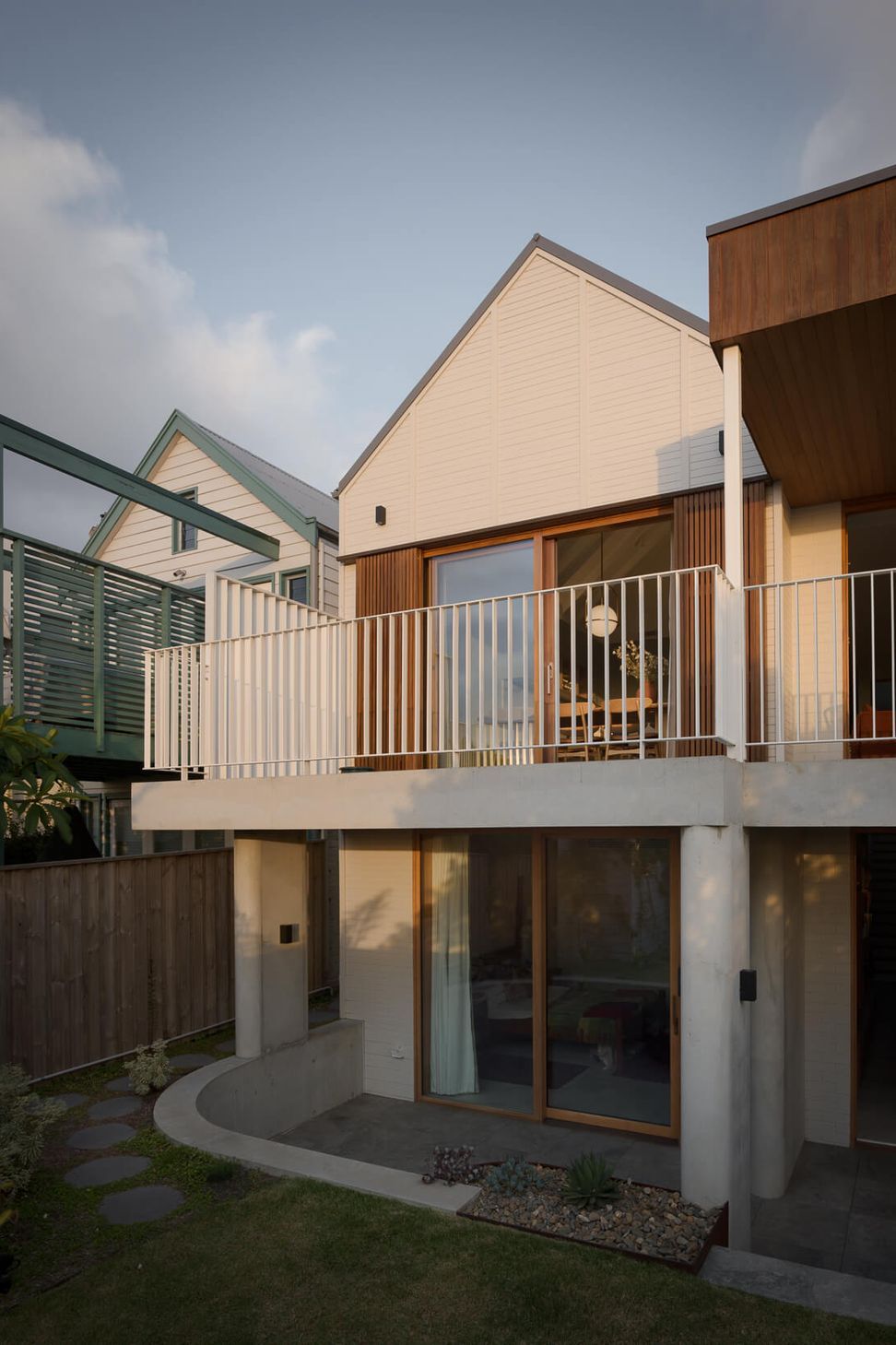
The front rooms have been reimagined as children’s bedrooms, flowing onto a reconfigured rear where the kitchen and living spaces with vaulted ceilings finally enjoy uninterrupted views across Berry’s Bay. Framed by custom-made BINQ timber lift‑and‑slide doors – “big and heavy,” Ed notes, “but the system lifts the panel onto tracks, so it rolls seamlessly” – this communal area opens onto a terrace, creating a connection with the garden.
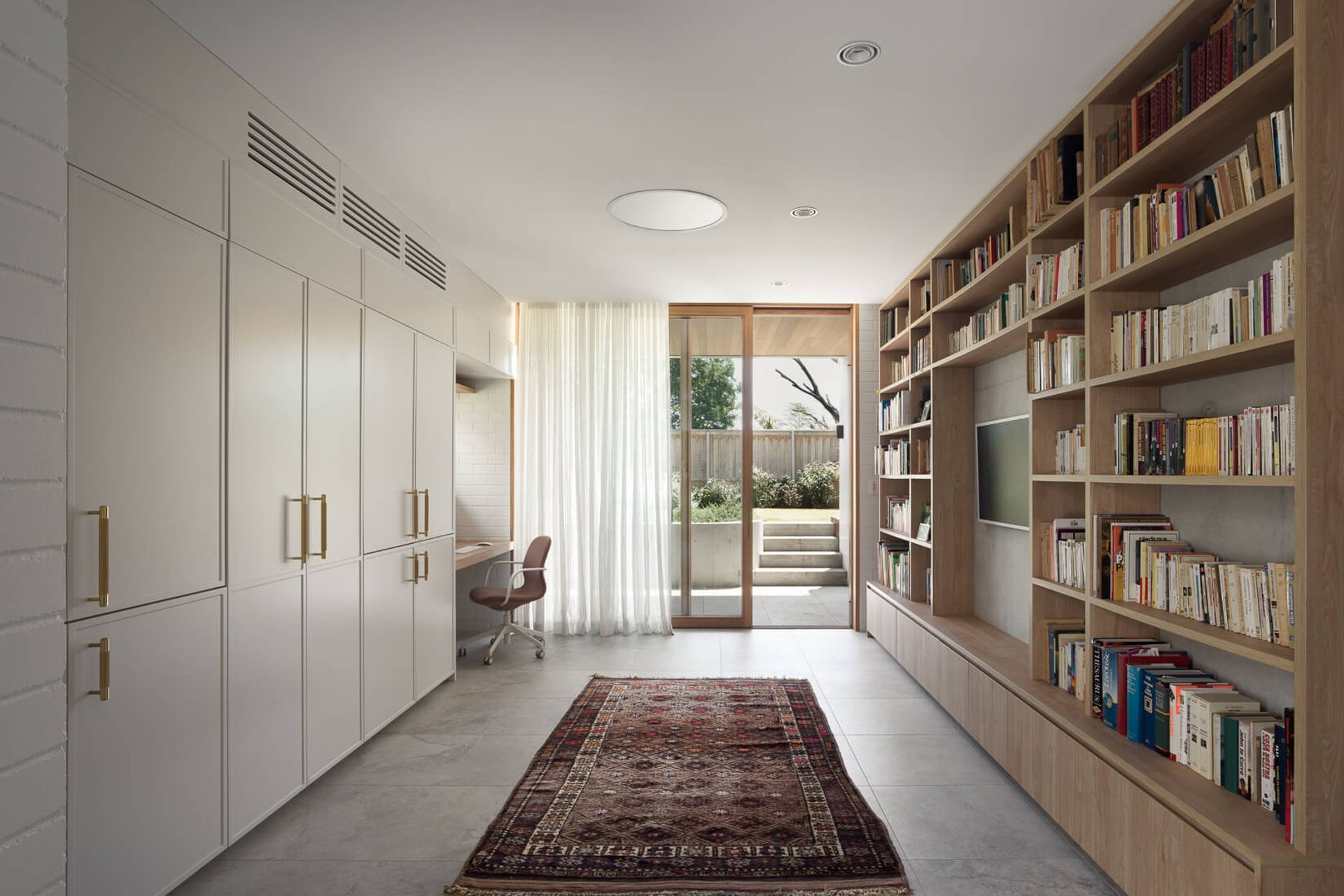
The semi‑subterranean level below serves as the grandparents’ domain, with a living room that doubles as a study, a kitchenette and sliding partitions that can close it off from the rest of the house. Beyond, an off‑form concrete blade wall anchors the plan, separating this living space from the primary suite and two additional bedrooms. A strategic integration of BINQ timber doors and windows fosters a connection to the courtyards and garden, creating generous pockets of light and transforming this bunker-like level into a calming Mediterranean‑style retreat that – Ed enthuses – “feels like you’re being given a big hug.”
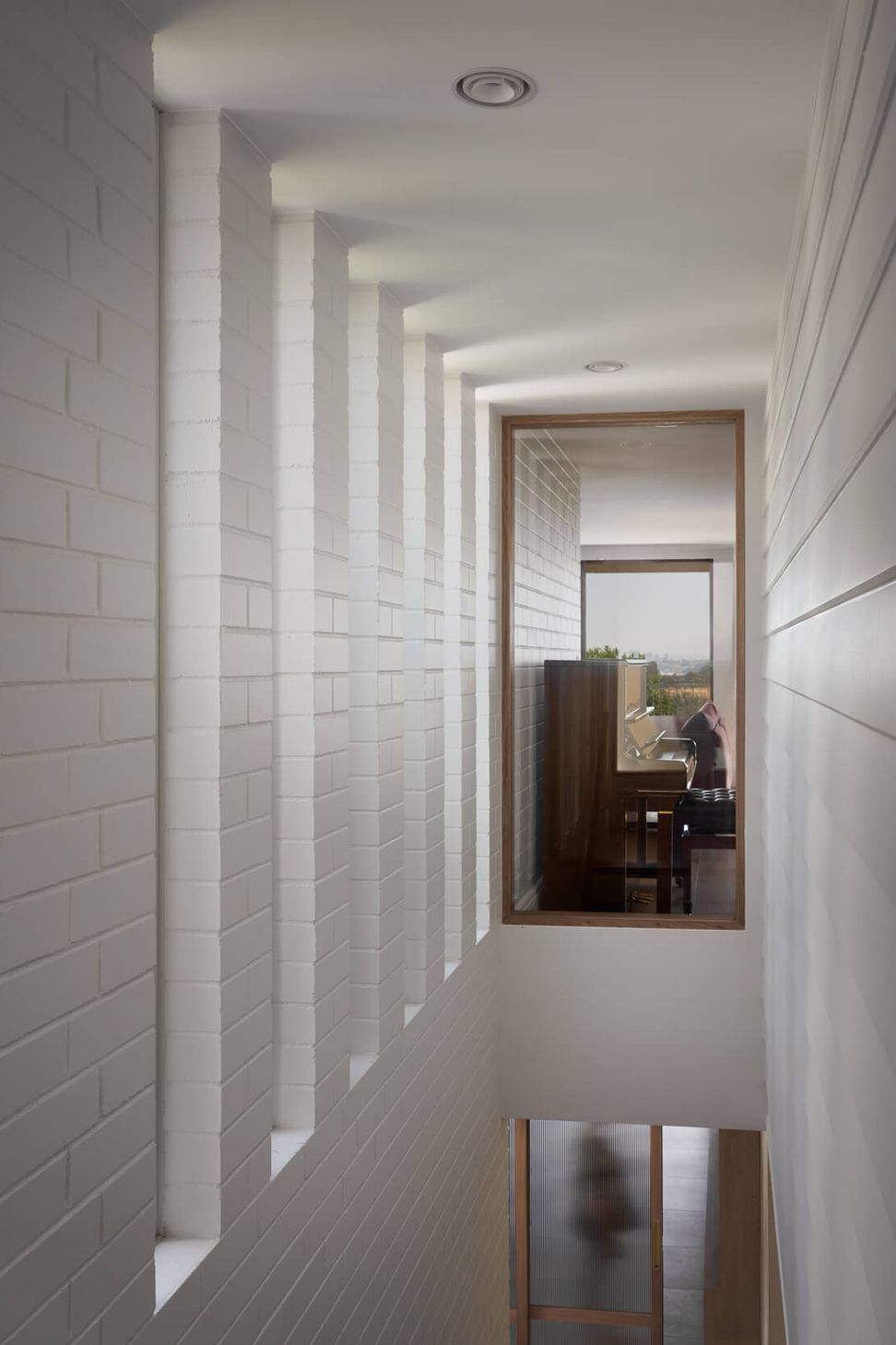
A small pavilion above stretches into a green roof and courtyard, pulling light and air deep into the plan and borrowing outlook for otherwise landlocked spaces, while the circulation strategy reinforces the dialogue between heritage and modernity, with parallel hallways tracing the original footprint and accommodating the wider stairs.
The home’s restrained palette also highlights the cottage’s architectural heritage while providing a quiet backdrop for the homeowners’ layered possessions accumulated over many years of travel. A slightly off‑white base is complemented by a cohesive expression of carefully curated timbers, including cedar cladding, sliding timber sunshades that soften the west‑facing elevation and the ash‑framed BINQ windows and doors that echo the restored cottage fabric throughout the house.
“Timber was a natural choice,” Ed remarks, noting the tactile quality of timber doors and windows. “It brings that slight element of warmth into what could have otherwise felt like quite an austere space.”
Technically, the openings are essential to the project’s performance strategy, which sought to upgrade the original cottage as much as possible, while treating the rest of the dwelling as if it were going to be a Passive House.
Services are consolidated into a plant room with heat recovery and air-to-water heat pumps, while a reverse brick-veneer buildup – a nod to the homeowners’ affinity for brick and concrete construction – underpins the project’s sustainable profile. “The internal is brick, then insulation, then timber framing with more insulation, and finally external timber cladding,” Ed explains. “By reversing it, we maintained insulation performance and encapsulated the thermal mass inside.”
Paired with high-performance BINQ openings, this shell serves as the primary thermal envelope, offsetting the single-glazed heritage elements and maintaining a stable, comfortable temperature. Having worked with BINQ across several projects – including certified Passive House homes – Ed knew their systems’ tested thermal performance would be critical at Thomas House. “They’ve done all the thermal‑bridging analysis,” he explains, “so we knew we were installing a tested system that would meet the performance requirements.”
BINQ’s European hardware plays a critical role: the multi‑point locks across doors and tilt‑and‑turn windows – “great for secure ventilation during the day,” Ed notes – guarantee airtightness when closed, while the four lift‑and‑slide doors at the rear “drop and seal into position when locked”, preserving the integrity of the envelope and contributing to a comfortable indoor environment all year round.
With the aluminium replacements and boxy rear extension now a distant memory and the vacant lot’s potential honoured and fulfilled, it’s clear that in filling the “missing tooth” in the streetscape, Thomas House has addressed a much more important void: the home sets a generous stage for both the buzz of multi‑generational family living and quiet moments to – at last – admire sunsets over Berry’s Bay.
“They love it,” Ed, who receives regular photo updates from the owners, says. For him, that outcome makes the initial effort required to retain the original home’s bones and character worth it. “The pain and heartache of that process give the project a sense of life and integrity,” Ed smiles as he sums up the home’s special quality that would have most certainly been lost if the dwelling had been rebuilt from scratch instead.
- Completed
- 2026


Project team

Edward Dieppe
Like this Project?
Hire BINQ Doors + Windows
Professional Reviews
The products behind the project
Three products specified into this build from one supplier, a verified ArchiPro member. Tap through to specifications, suppliers and lead times.


Professionals used in
this project
The practices and trades credited on this project.

More projects from
BINQ Doors + Windows
Other work by BINQ Doors + Windows, across every category they build in.


More in
Renovations
Everything else in Renovations, from every practice on ArchiPro.


Next Project
Keep scrolling