
Project team
- Porebski Architects
- Jack Lovel
Product Suppliers
On Victoria’s Mornington Peninsula, Porebski Architects crafts a timber retreat that brings together vineyard views, a rural vernacular and a long-standing client relationship.
A vineyard retreat in two pavilions
Set among the undulating slopes, bush-clad pockets and tawny grapevines of Victoria’s Mornington Peninsula, Main Ridge was designed almost as a test case for the clients, whose Portsea estate plays host to family, friends and members of the vineyard’s wine club. The timber-clad accommodation sits within the expansive grounds, and was one of many concepts Porebski Architects had conceived for the couple over the past 20 years.
“We’ve been playing with various concepts for their main house at Portsea, but while they’ve been procrastinating on what to do, we’ve done a whole lot of little timber sheds around the property,” says architect Alex Porebski. “We did a timber timber shed with a studio, a wine tasting pergola and a timber viewing platform. They really started to embrace timber, so when it came to the Main Ridge house it was an obvious choice for them.”
The house was envisioned as an extension of the estate’s hospitality offering. The owners host celebrity chef events and long-table dining experiences at Portsea Estate, and the new dwelling allows guests to fully immerse themselves in the landscape.
An existing house once occupied the site, but it quickly became clear that preservation would compromise the potential of the landscape.
“Originally we looked at keeping the existing house, but I could tell straight away it wasn’t worth it,” Porebski explains. “It wasn’t doing enough to make the most of the beautiful site.”
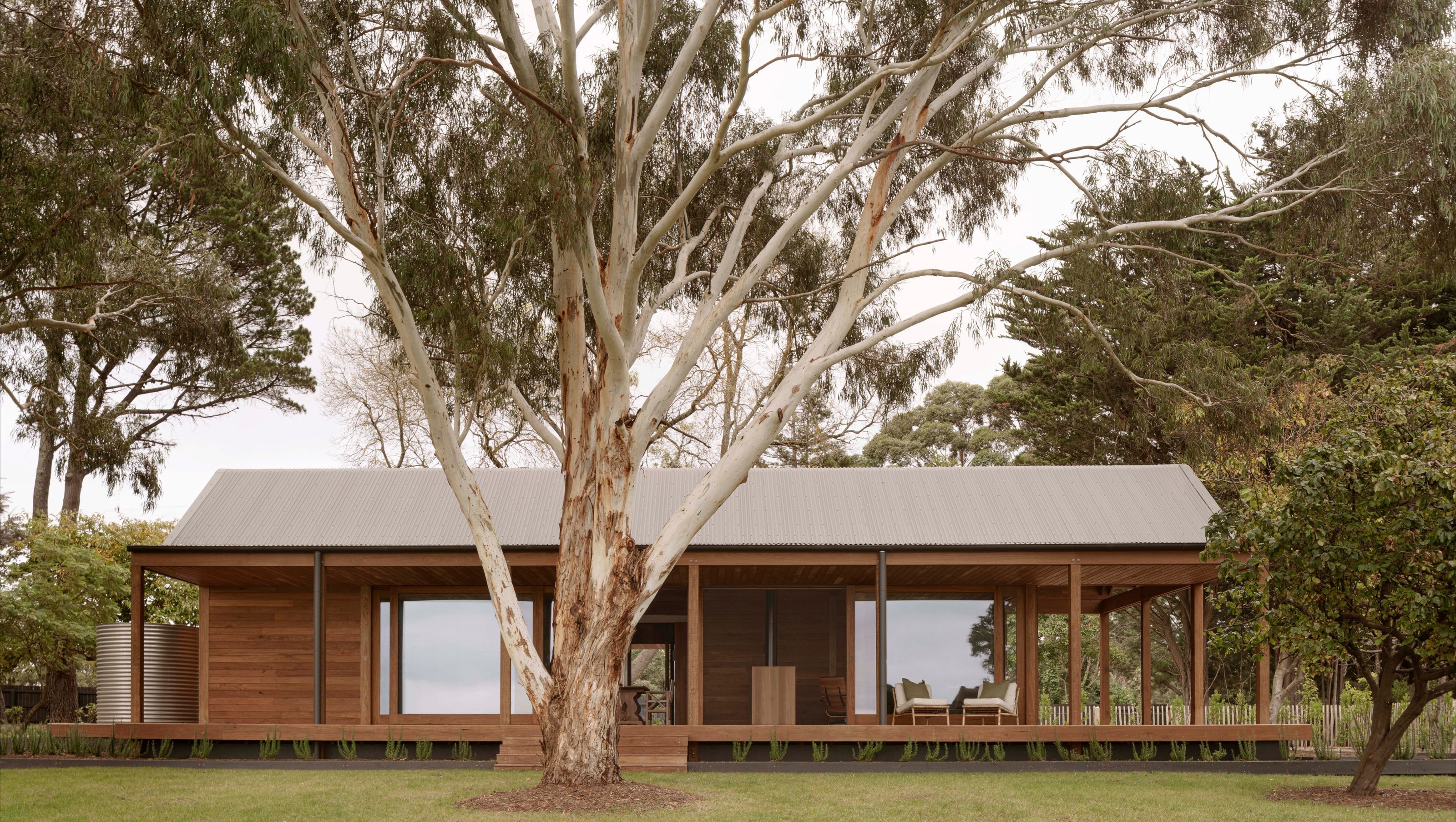
Instead, the architect proposed a pair of timber pavilions connected by a breezeway, a move that brought clarity to both the planning and experience of the house. Drawing from a familiar rural typology, the design balances farmhouse symmetry with a distinctly contemporary spatial rhythm.
“They do like the rural vernacular, so they wanted verandas where they could sit outdoors,” says Porebski. “To keep the building humble in scale, I thought it would be nice to have sleeping areas separate from the living spaces, and to create two pavilions rather than one large house.”
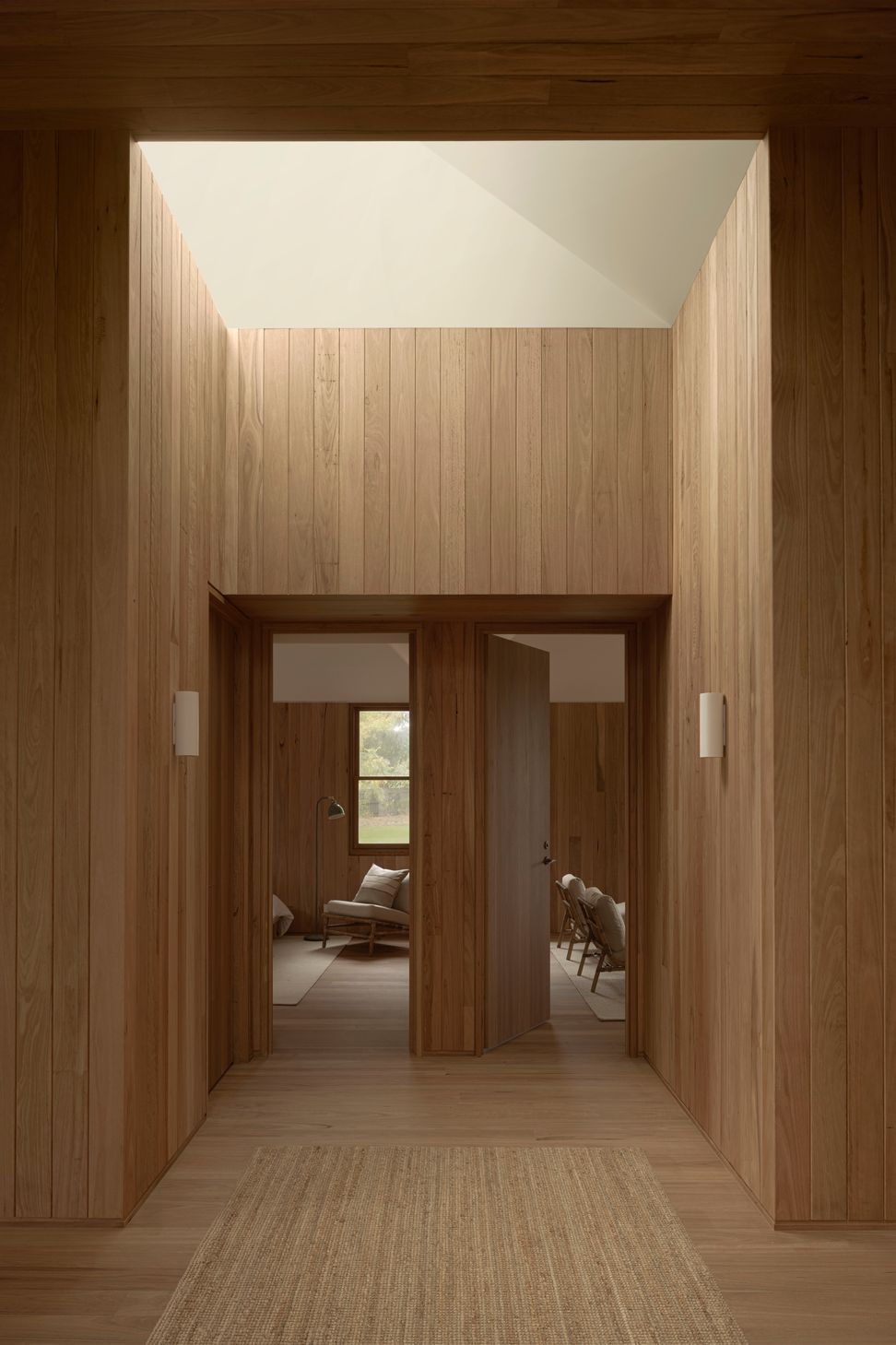
The separation allows the house to unfold gradually through a sequence of compressed and expansive moments. Entry begins at the bedroom pavilion, where a veranda leads into a timber-lined hallway punctuated by skylight shafts that draw natural light deep into the centre of the home. Beyond, the breezeway opens dramatically into the living pavilion, where soaring rafters and cathedral-like proportions frame expansive views towards Prospect Hill Basin.
“It’s got a quite natural progression of spaces and volumes as you walk through the house,” Porebski says. “There’s a sense of compression and release throughout the spaces, similar to the feel as you walk through a forest and the tree canopies open and close between trees.”
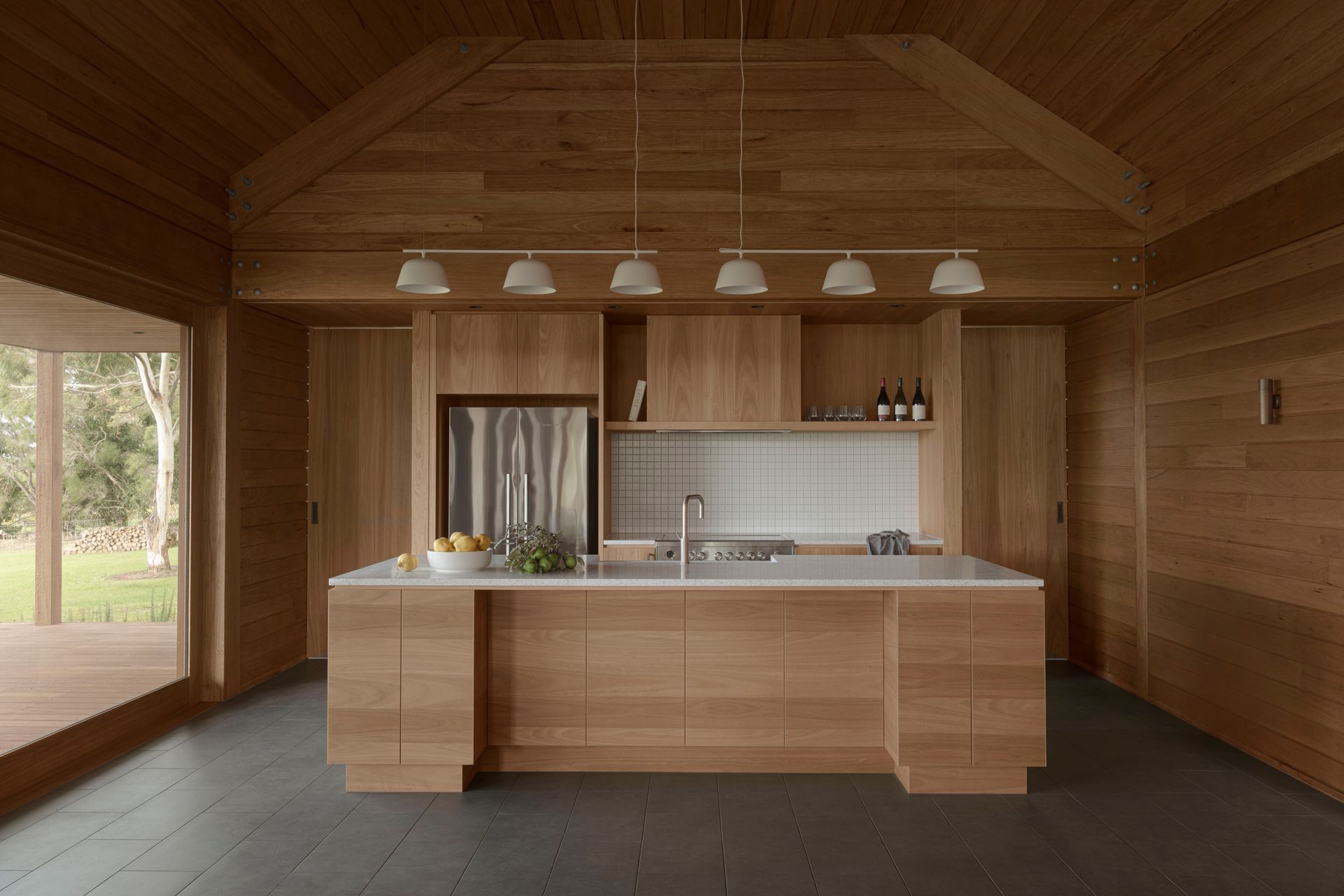
That choreography of movement is reinforced by the home’s material palette. Blackbutt timber wraps the exterior and expresses much of the structure internally, creating warmth and texture against the muted tones of plasterboard-lined bedroom walls and ceilings. The restraint prevents the interiors from feeling visually heavy while allowing the richness of the timber detailing to remain central.
“The junctions between materials are beautifully finished,” says Porebski. “Because we were working from Sydney, I was very pleased because we put a lot of faith in the builder and he did a great job following our documentation."
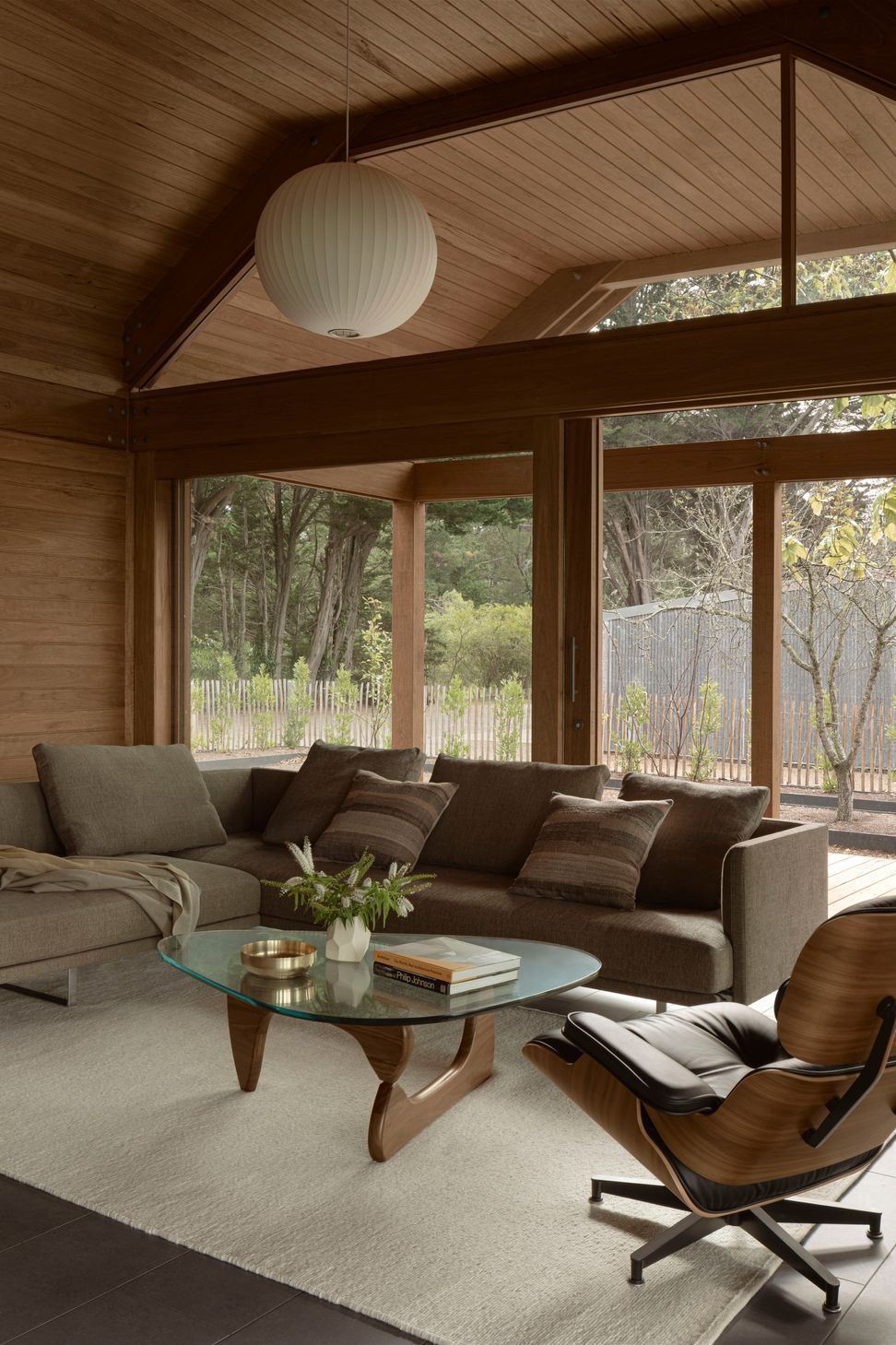
The living spaces are where the architecture fully opens to the landscape. Large custom sliding doors measuring approximately 2.6 metres high by three metres wide dissolve the threshold between inside and out, while deep verandas extend the sense of shelter into the surrounding bush and vineyard.
“There’s a big gum tree, and in a way that became the focal point and the centre line of the house,” says Porebski. “When you’re sitting in the living area looking out to the view past the gum to the vineyard, it’s just beautiful.”
That connection to site informed more than just the outlook. The dual pavilion forms echo the surrounding trees and stumps scattered across the property, while the house itself appears to hover lightly above the terrain. Elevated slightly from the ground and gently cantilevered, the building avoids imposing too heavily on the bush setting.
“We have designed the building to feel as if it’s floating,” Porebski explains. “There is a sense of it being gently cantilevered, which creates a nice softness, rather than it being flat on the ground.”
Comfort was also integral to the brief. A gas fireplace anchors the living area, underfloor heating warms the tiled floors, and deep verandas provide shaded outdoor rooms that invite year-round use. Facing east to capture the morning light and vineyard views, the home balances openness with intimacy.
For the owners, the retreat has become more than guest accommodation. “They love it,” says Porebski. “They have actually stayed there a few times too, and really enjoyed the experience of the space.”
After years of exploring ideas for the estate’s main residence, Main Ridge may also represent something of a turning point. In its timber forms and carefully resolved spaces, the project captures a direction the owners have gradually embraced over decades of collaboration with Porebski Architects. Perhaps this small retreat among the vines is not simply a guest house after all, but the beginning of the estate’s next chapter.
Great architecture is often found in the careful reworking of what already exists. Through considered planning, refined materiality and a stronger connection to landscape, this Paddington terrace shows how existing homes can be transformed to better support contemporary living. Discover more exceptional projects and design inspiration on ArchiPro.
- Completed
- 2025
- Building style
- Modern





Like this Project?
Hire Porebski Architects
The products behind the project
Seven products specified into this build from two suppliers, verified ArchiPro members. Tap through to specifications, suppliers and lead times.


Professionals used in
this project
The practices and trades credited on this project.



More projects from
Porebski Architects
Other work by Porebski Architects, across every category they build in.


More in
Rural / Estate / Lifestyle
Everything else in Rural / Estate / Lifestyle, from every practice on ArchiPro.


Next Project
Keep scrolling