
Project team
- IF Architecture
- Sharyn Cairns
Product Suppliers
IF Architecture turns its own studio into a public-facing laboratory for colour, material and spatial experimentation.
Testing ground: Inside an interior design studio’s own workspace experiment
As an architecture and interior design studio, designing your own workspace is both a blessing and a curse. It is a chance to explore ideas that have not yet found their way into client projects, to test materials and spatial strategies at full scale. At the same time, there is a fine line between expression and excess. Push too far into personal territory and the risk is that the space no longer resonates with the very clients it is meant to engage. This was the balancing act facing IF Architecture as it reimagined its Melbourne studio.
Located in Collingwood, a couple of kilometres from the CBD, the practice has spent the past decade embedded in a neighbourhood that has steadily transformed from light industrial fringe to creative hub. The move itself was not far. The team remained in the same building, shifting from a first floor tenancy into a ground floor space that opens directly onto the street. The change, however, brought with it a new level of exposure and opportunity.
“The opportunity came up to take on this studio, and to connect with the laneways,” shares IF Architecure director Iva Foschia. “Given that we have so much exposure to the street, it just felt like a really good opportunity to really express ourselves, to have a dialogue with people walking or driving past.”
For Iva, the process of becoming both designer and client was not without its challenges.
“For me it was hard! Because we see so many amazing things, and have access to so many amazing projects, it initially felt quite overwhelming to settle on an idea.”
What has emerged is a studio that operates as both workplace and working prototype. Within a relatively compact footprint, the design accommodates a range of functions, from focused desk work to spaces for client presentations, supplier meetings, and informal conversations. Rather than segmenting the plan into fixed zones, the approach relies on adaptable elements that allow the space to shift as needed throughout the day.
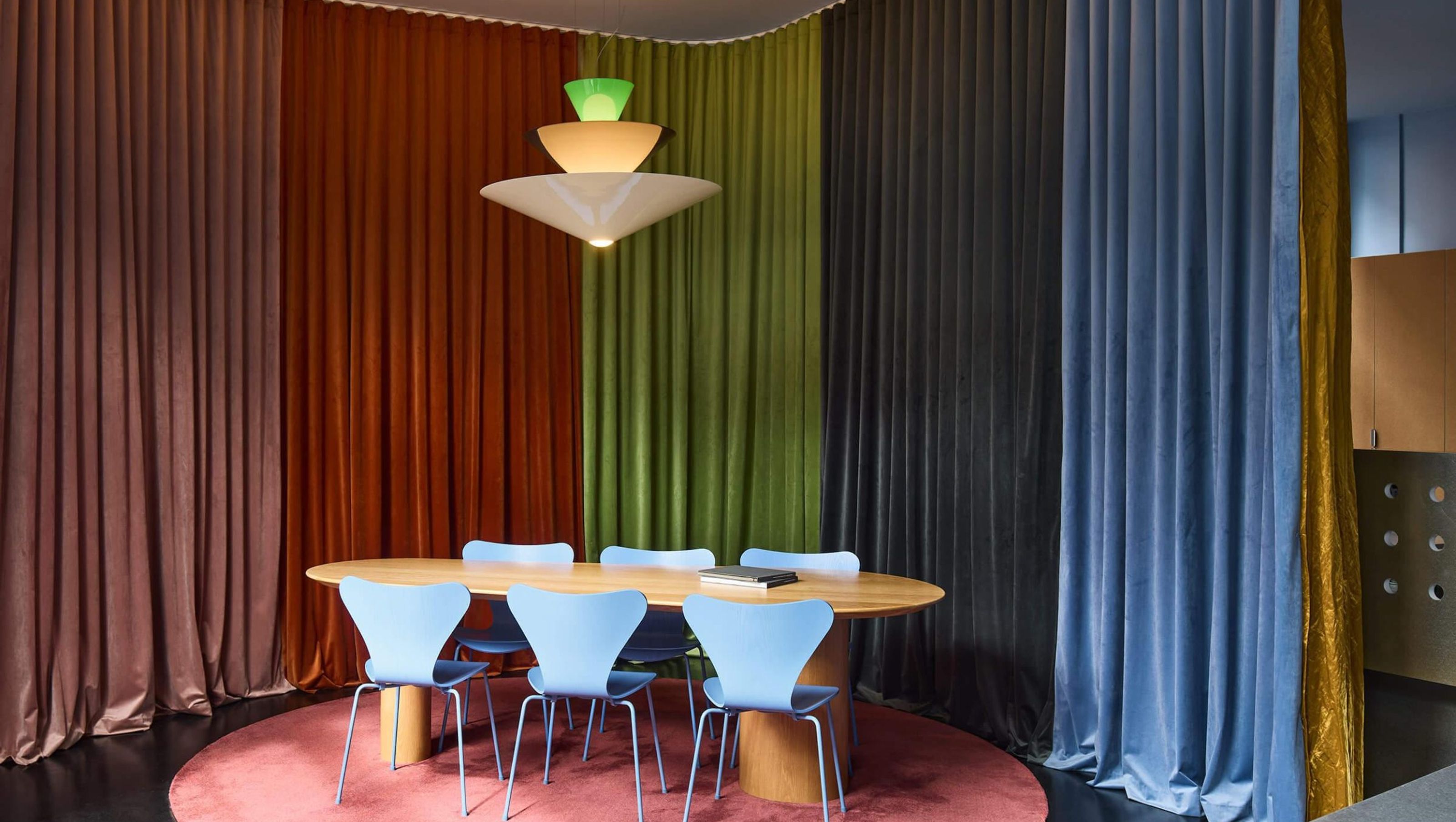
A velvet curtain in stripes of jewel tones provides one of the most distinctive gestures. Referencing the theatricality of a stage reveal, it introduces a sense of performance while serving a practical role in dividing the space.
“In its open position, it’s a beautiful backdrop to the space, while on the reverse side, it’s a beautiful gold, offering a different experience to the space that interacts with that side.”
Colour, more broadly, is used with confidence. In a profession where neutrality often prevails, IF Architecture has taken a deliberate stance, embracing hues that evoke mood and identity rather than playing it safe.
“We love colour—but it can be really polarising. Our point of view is that it’s really good to have a point of view. When you design something for everyone, it will end up being a kind of ‘nothing’.”
That thinking is immediately legible within the studio itself. A saturated blue forms the backdrop to the main working area, grounding the space in a calm, reflective tone while giving it a distinct visual identity. It is both confident and considered, setting the stage for the material and spatial explorations that unfold across the interior.
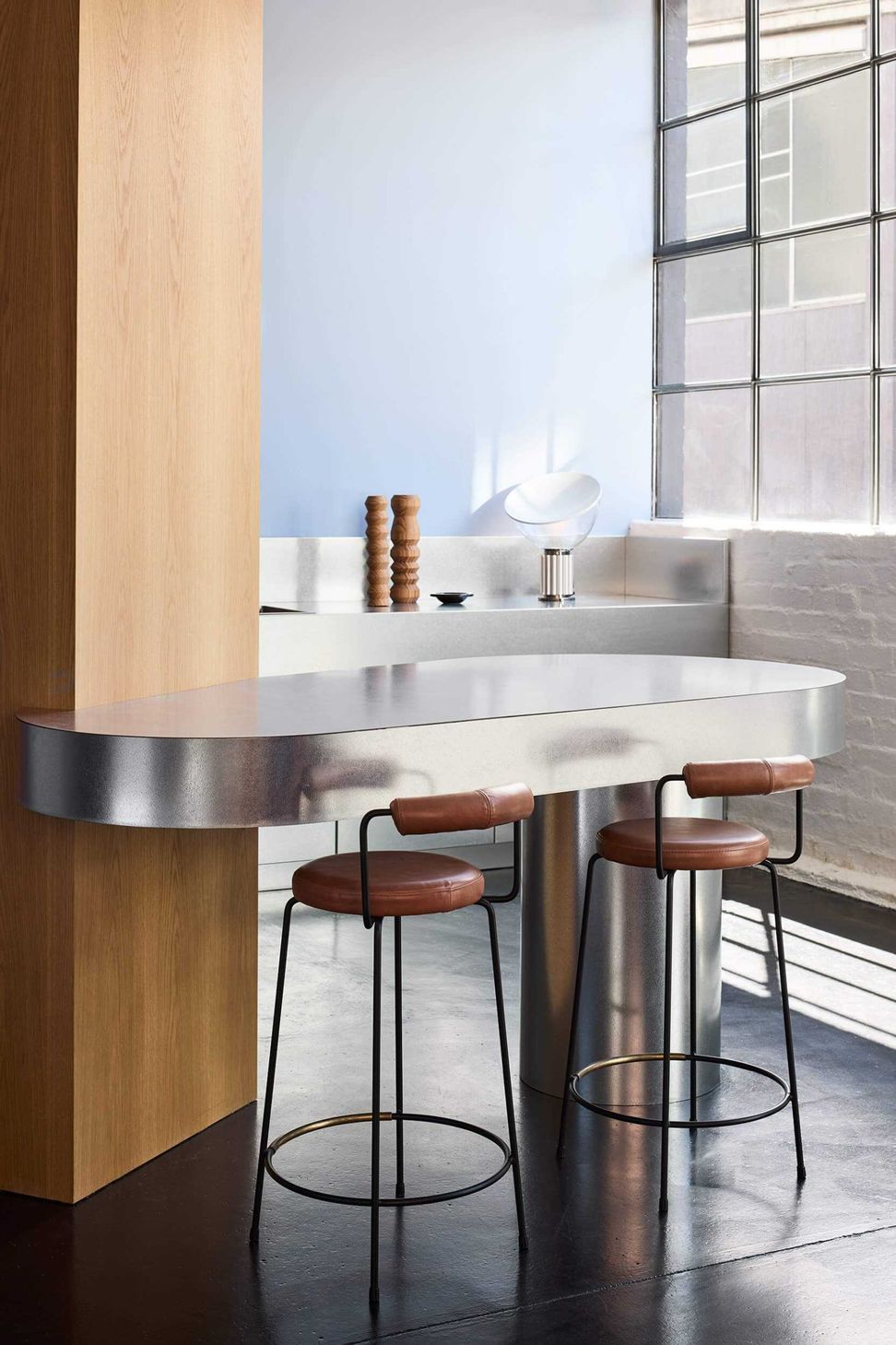
Material experimentation sits alongside this. Galvanised steel, typically associated with more industrial applications, is used extensively throughout the studio. Its inherent durability and patina are balanced by the warmth of timber and the softness of fabric, creating a layered and tactile environment.
“We wanted to be able to show that it could be used in a smaller-scale environment—it doesn’t necessarily need to have that association of being cold or too mechanical,” shares Iva.
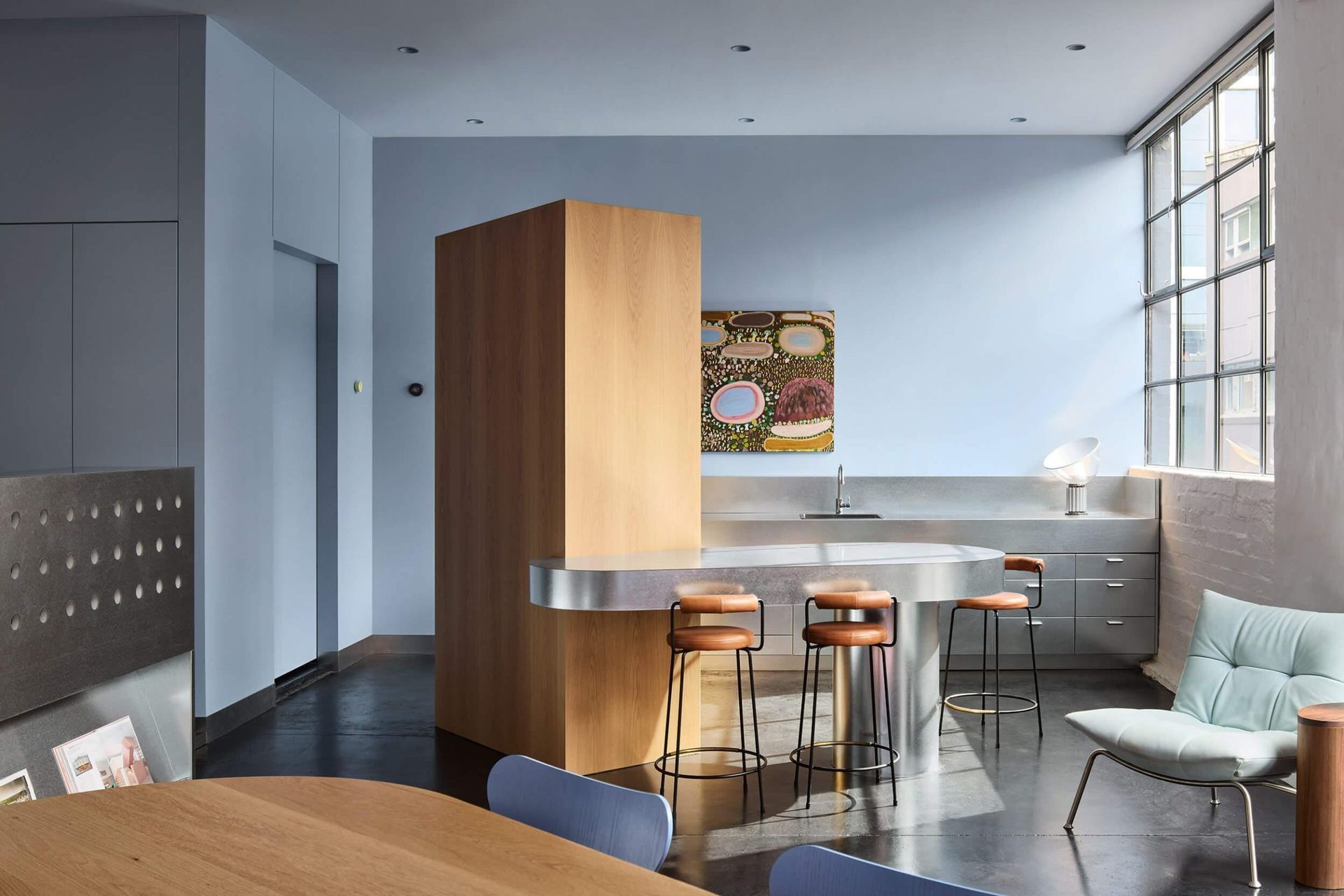
The kitchen offers another point of departure from convention. Rather than adhering to a linear arrangement, it is conceived as a sculptural series of volumes that help define and divide the space. This configuration introduces moments of privacy without enclosing them entirely, allowing the kitchen to be used while the adjacent informal meeting area is in session.
“The upright volume in the kitchen house the fridge, and it also provides a bit of privacy if you’re making a cup of tea. It shows that a non linear or traditional kitchen arrangement is possible and that it works functionally really well.”
Storage, too, has been carefully considered. Concealed systems integrate slide-out drawers for flat lays and curated display zones for materials, ensuring that the studio’s extensive library remains accessible without overwhelming the space. Everything has its place, allowing the team to maintain both clarity and efficiency in their workflow.
Underlying the entire project is a focus on longevity. Despite being a leased space, the studio has been fitted out with a long-term mindset, prioritising materials and systems that will age well and continue to perform. It is an investment not only in the space itself, but in the ongoing evolution of the practice.
In use, the studio has proven its value. Multiple activities now unfold simultaneously with ease, from presentations to supplier visits and everyday work. The environment supports the teamto operate fluidly without the constraints of their previous open plan setup.
“We’ve had multiple things going on here at once: someone doing a presentation, a supplier coming in, a Zoom call happening, and all of those things have managed to happen alongside each other. We haven’t had to programme the way we used to,” shares Iva.
For clients, the experience is immediate and tangible; the rich and sculptural studio space communicates IF Architecture’s approach through an immersive experience that is resolved with clarity.
Words: Joanna Seton
The studio spaces offers an environment in which clients can engage directly with the practice’s design thinking. Through material experimentation, spatial testing, and considered detail, it embodies IF Architecture’s approach—encouraging collaboration and inspiring the creation of projects that are both bold and inventive.
Within a compact footprint, the studio is organised as a series of interconnected spaces shaped through adaptable, multipurpose elements. Bathed in a soft blue colour field, establishing a calm yet deliberate backdrop for daily work.
Departing from a conventional layout, the formal meeting area is positioned at the centre of the studio and anchored by a bordeaux-coloured rug, establishing a clear spatial focus within the open plan. This central space is defined by a double-sided curtain composed of multicoloured, rainbow-striped velvet in rose pink, orange, green, grey, and blue, with a gold satin lining forming its reverse.
Drawing reference from the iconic Tonight Show with Johnny Carson opening—when Johnny Carson would emerge from behind the curtain for his monologue—the gesture is both theatrical and purposeful. Functionally, the curtain provides visual and acoustic privacy for meetings, while offering an equally considered experience to the working area beyond, balancing performance, utility, and atmosphere.
The informal meeting and kitchen area is realised as a composition of freestanding joinery. A pantry and fridge volume in American oak veneer is detached from the perimeter, forming a clear object within the plan. From this volume, a cantilevered galvanised steel island extends into the room, complemented by a matching steel bench along the rear wall. Together, these elements test an alternative arrangement that supports flexibility, material contrast, and use beyond a single function.
Both the conference table and the cantilevered island employ a teardrop geometry—a strategy originally developed through earlier hospitality work and further tested within the studio. Refined here, the form subtly directs orientation and use, ensuring clear sightlines to presentations in the meeting space while encouraging intuitive movement and occupation around the bench.
Open-plan workspaces are articulated by a galvanised steel partition and subtle changes in floor level. Circular perforations within the partition balance privacy with visual connection across the studio. On one side, a low-angled shelf presents a curated library of published projects; opposite, a desk-height shelf displays objects integral to the design process, including prototypes, material samples, and reference texts.
A cork-clad joinery volume introduces a strong vertical element, providing a dedicated space for traditional pin-ups and collaborative review. Concealed flexible shelving supports material testing, sample storage, and ongoing design development, allowing the studio to remain visually clear while accommodating an active, iterative process.
Collectively, the studio operates as a live testing ground for IF Architecture’s ongoing design research. Ideas developed here are continually refined through use, conversation, and iteration, informing projects beyond the studio itself. In this way, the space remains deliberately unfinished—evolving alongside the practice and reinforcing design as an active, exploratory process.
- Completed
- 2025
- Building style
- Modern





Like this Project?
Hire IF Architecture
The products behind the project
One product specified into this build from one supplier, a verified ArchiPro member. Tap through to specifications, suppliers and lead times.

Professionals used in
this project
The practices and trades credited on this project.


More projects from
IF Architecture
Other work by IF Architecture, across every category they build in.


More in
Office
Everything else in Office, from every practice on ArchiPro.


Next Project
Keep scrolling