Curved Timber Click-on Battens
by Sculptform
Auckland, New Zealand

- 50.0K profile views
- 3 saves
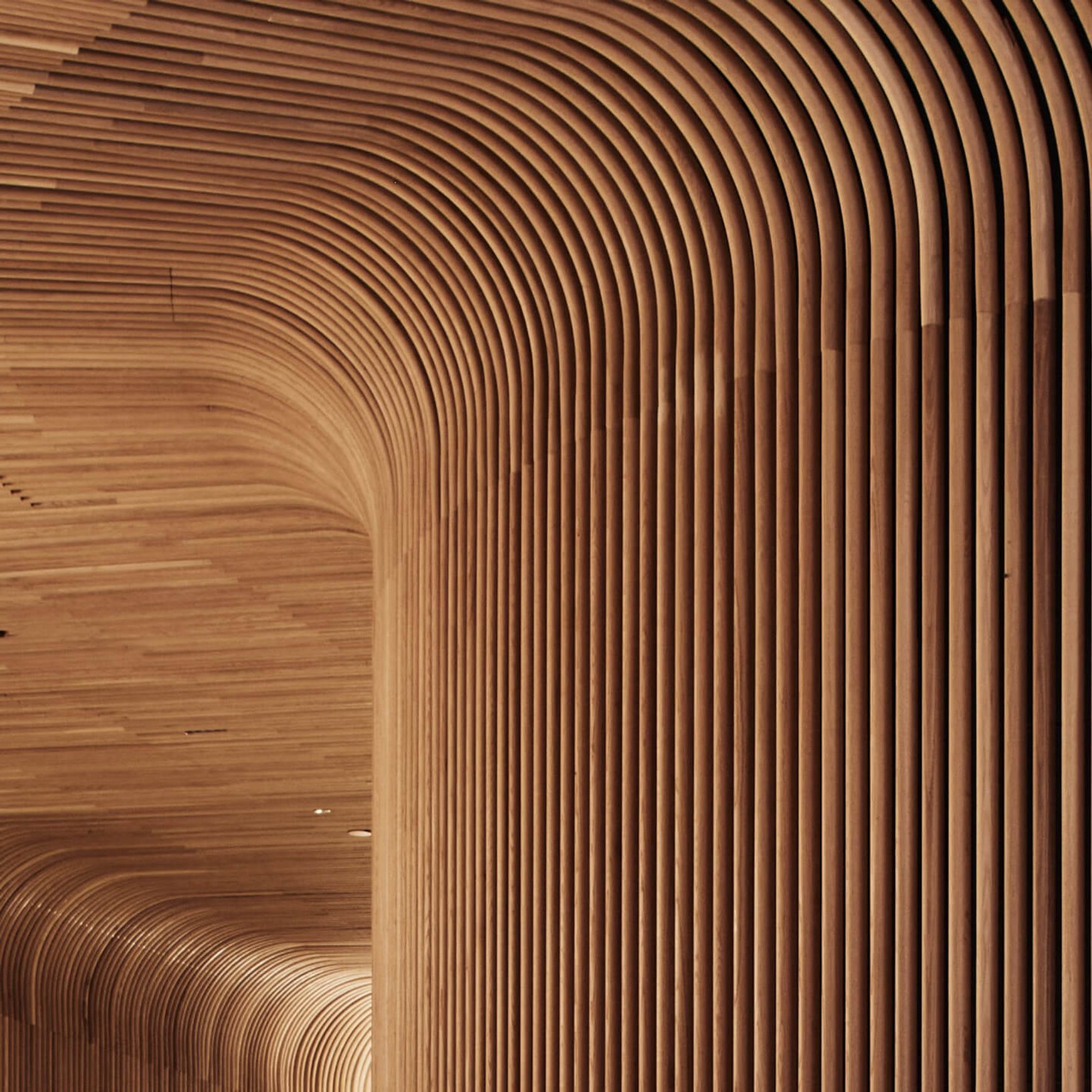
Curved Timber Click-on Battens allow architects and designers to create flowing, organic forms across walls and ceilings.
How it works:
Our curved timber integration into our Timber Click-on Batten system combines simple, fast installation with either of our curving options – Steam Bending and Kerfing. Built on Sculptform’s patented Click-on technology, the system ensures precise alignment and fully concealed fixings, making complex curved designs practical and easy to install.
Steam Bending:
Our process takes the traditional art of steam bending timber and applies it on a larger commercial scale. Through a process of steaming and heating, the timber can be formed to the required shape without resistance. After the timber is held in place for the cooling period, it maintains the curved timber form. Suitable for interiors only.
Kerfing:
The process of kerfing involves cutting small notches in the back of the timber batten to allow the timber to be flexed around a substructure to create the forms or curves. The timber battens are provided pre-kerfed to site in straight, but flexible lengths. Suitable for interiors and sheltered exteriors.
Features & Benefits
Create large scale curves:
Our curved timber manufacturing methods allow designers to create large scale curves in the beauty of natural timber. Seamless transitions between planes such as a wall and ceiling provide a unique handcrafted aesthetic on a commercial scale.
Systemising the Sculptural
We can manufacture curved timber on such large scale by combining the bending process with our Timber Click-on Battens System. The benefits of the established system carry across, ensuring customisation and fast, accurate installation.
Range of options
To allow unrestricted design with curved timber, we offer two different methods of bending – Steam bending and Kerfing. Each of these methods has a range of strengths, offering a solution that meets the unique requirements of each project.
Product Details
- Product
- Curved Timber Click-on Battens
- Category
- Timber Cladding
- Sold by
- Sculptform
- Range
- Timber Range
Product specified by

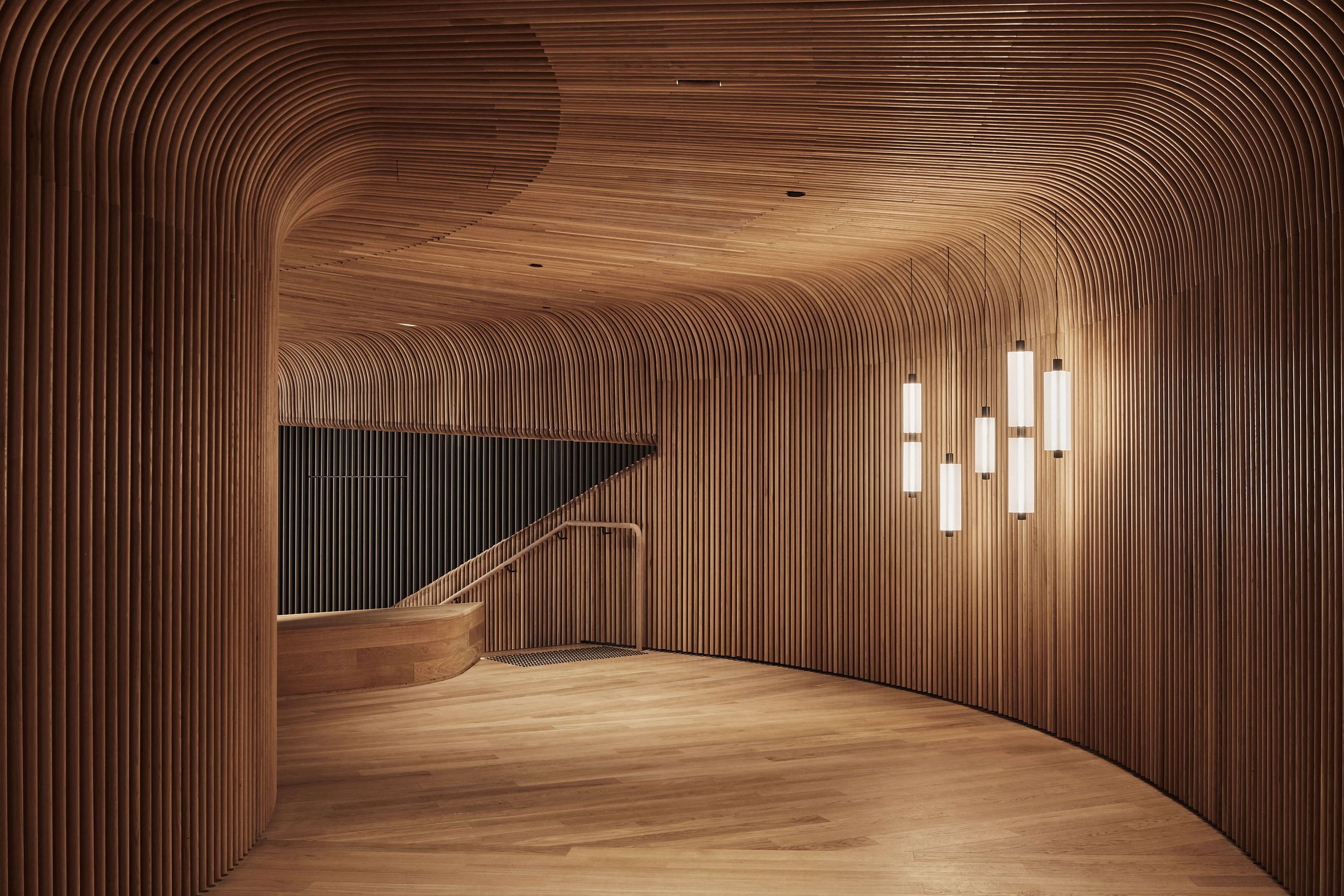
Curved Timber Click-on Battens allow architects and designers to create flowing, organic forms across walls and ceilings.
How it works:
Our curved timber integration into our Timber Click-on Batten system combines simple, fast installation with either of our curving options – Steam Bending and Kerfing. Built on Sculptform’s patented Click-on technology, the system ensures precise alignment and fully concealed fixings, making complex curved designs practical and easy to install.
Steam Bending:
Our process takes the traditional art of steam bending timber and applies it on a larger commercial scale. Through a process of steaming and heating, the timber can be formed to the required shape without resistance. After the timber is held in place for the cooling period, it maintains the curved timber form. Suitable for interiors only.
Kerfing:
The process of kerfing involves cutting small notches in the back of the timber batten to allow the timber to be flexed around a substructure to create the forms or curves. The timber battens are provided pre-kerfed to site in straight, but flexible lengths. Suitable for interiors and sheltered exteriors.
Features & Benefits
Create large scale curves:
Our curved timber manufacturing methods allow designers to create large scale curves in the beauty of natural timber. Seamless transitions between planes such as a wall and ceiling provide a unique handcrafted aesthetic on a commercial scale.
Systemising the Sculptural
We can manufacture curved timber on such large scale by combining the bending process with our Timber Click-on Battens System. The benefits of the established system carry across, ensuring customisation and fast, accurate installation.
Range of options
To allow unrestricted design with curved timber, we offer two different methods of bending – Steam bending and Kerfing. Each of these methods has a range of strengths, offering a solution that meets the unique requirements of each project.
- Specs
Steam Bent Timber
Timber Click-on Battens Tech Info:
The information on this page is specific to steam bent timber battens. For all other information on the use of timber battens, see our Timber Click-on Battens technical information page. These products can be used together – eg. ceiling to curved bulkheads.Profiles available for Steam Bending:
Not every profile in our standard range is available for steam bending due to profile and size constraints. The species chosen can also make a difference to the profiles available. Refer to the steam bending parameters table below to confirm.Block:
*32x32mm not available in Spotted GumDome:
*Integrated kerfing required for Spotted GumSpecies and Coatings:
Due to the steam bending process, we offer a limited range of timber species of coatings in our curved range. As with our entire range of products, custom solutions are available.Curve Direction Options:
Concave means “hollowed out or rounded inward” and is easily remembered because these surfaces “cave” in. The opposite is convex meaning “curved or rounded outward.” Both words have been around for centuries but are often mixed up.Standard Radii:
Each radius requires specialised equipment (formers) in order to produce the curved timber battens. To save on costs, we offer a range of radii as standard. Any custom radius within the parameters can be achieved, contact us to discuss your specific project requirements.Please also refer to the steam bending parameters table below to see what the actual profile and species combination can bend too. Eg 300mm is a standard radius, but you cant bend a 32x19mm batten in white oak in the convex direction more than 500mm. The standard radius figures shown are subordinated to the parameters table below.
Standard Inner Radii:
- 300mm
- 400mm
- 500mm
- 600mm
- 800mm
- 1000mm
Steam bending parameters:
The most important restriction with steam bent timber is the radius of the curve. Each timber species and profile combination performs differently when curved, with the minimum and maximum parameters for each shown below.White Oak
Profile - Minimum Inner Radius (Concave) - Minimum Inner Radius (Convex) - Maximum Angle- Block 32x19mm - 300mm - 500mm - 180°
- Block 42x19mm - 300mm - 500mm - 180°
- Block 60x19mm - 300mm - 500mm - 180°
- Block 32x32mm - 500mm - 700mm - 90°
- Dome 32x32mm - 500mm - 700mm - 90°
- Dome 32x32mm - 500mm - 700mm - 90°
Spotted Gum
Profile - Minimum Inner Radius (Concave) - Minimum Inner Radius (Convex) - Maximum Angle- Block 32x19mm - 500mm - 700mm - 180°
- Block 42x19mm - 500mm - 700mm - 180°
- Block 60x19mm - 500mm - 700mm - 180°
- Dome 32x32mm (requires integrated kerfing*) - N/A - 900mm - 90°
- Dome 42x32mm (requires integrated kerfing*) - N/A - 900mm - 90°
Customised solutions are always available. Please contact us to discuss your specific project requirements.*Kerfing is the method of putting small cuts in the back of the back of the batten to assist the steam bending process.
Join Line Options:
While steam bent timber lessens the number of joins required for a curved application, some joins are still required. Find our options for join lines below.Aligned Joins:
Aligned joins maintain the join line throughout the wall or ceiling, ensuring consistency.Staggered Joins:
Staggering the joins in the curved timber can lessen the disruption to the aesthetic, making it a perfect option for a ‘seamless’ look. 2 – 3 alternating curved battens are supplied, allowing the joins to be located at different locations which helps to blend the join line. The length of your required curved battens could affect your ability to achieve this. Please refer to our maximum and minimum length section.Steam Bent Timber Details:
- Bulkhead Detail - DOWNLOAD DWG DETAILS
- Ceiling to Wall Transition - DOWNLOAD DWG DETAILS
Minimum and Maximum Lengths:
Our curved timber process limits the lengths of timber achievable. The maximum length achievable is 2000mm, where the minimum length is 1300mm. This can be trimmed on-site to suit requirements.Minimum Order Quantity:
We enforce a minimum order quantity of 100 steam bent battens to ensure the technical process remains viable. This works in conjunction with our overall MOQ of AU $5000. Find out more here.Other Considerations:
Compression Marks:
Due to the compression taking place in the grain of the timber during the stream bending process, compression marks may occur.Imperfections in the curve:
While the steam bending and cooling process ensure the timber will hold the curve, grain and density variations can affect the overall curve. This is unavoidable due to the natural variation in timber.Timber Click-on Battens Tech Info:
The information on this page is specific to kerfed timber battens. For all other information on the use of timber battens, see our Timber Click-on Battens technical information page. These products can be used together – eg. ceiling to curved bulkheads.Profiles available for kerfing
The process of curving timber through kerfing is not suitable for all the timber profiles we have available. The range below has been tested and will perform well when kerfed.Species and Coatings:
Due to the requirements of the kerfing process, we offer the following species and coatings for kerfing applications. Custom solutions are always available, contact us here to talk about your project.Kerfing Details:
Kerfing is the process of cutting small notches in the back of the timber batten to allow it to curve. Our kerfed battens are provided to site straight but flexible to allow for fixing to curved forms on-site.Joining Kerfed Battens:
Stiff aluminium joiners (shown below) are supplied to bridge between two battens at the butt joins. This will stop the battens tendency to tent or peak at the butt joins.Clip Options:
Our kerfed timber integrates with our timber Click-on Battens system and uses our patented clip connections. The two most common methods of fixing the battens are- Our standard track system, using mounting tracks with prefixed clips to hold the battens in place.
- Using direct fix clips to ply forms, which are attached to the substrate and form the shape of the curve. This method is useful for complex applications.
Contact Sculptform here to discuss how which method best suits your project.
Ply Form / Track Spans:
300mm between clip connections.Space between battens:
There is no limitation here however, we recommend 5mm to 10mm to limit visibility of kerfing behind the battens. We are working on a profile with tapered sides to minimise the visibility of the kerfs.Minimum bending radius (inner):
The minimum inner radius that can be formed by kerfing is 1.5 meters.- Applications
Understanding steam bent timber
Our curved timber can achieve a huge range of looks to meet almost any design intent. To help inspire your creativity, we have provided the renders below to show some suggestions. View the technical data for our curved timber here, or contact us to talk to our team about one of our customised solutions.- Installation
At Sculptform we understand that the design of a project is only half the journey, and installing our products the right way is essential to achieving a quality outcome.
The following choices are available to provide you as designers, main contractors and subcontractors with an option that suits your every need.
Sculptform Supply and Install:
Sculptform can now offer supply and install to main contractors. This allows you complete confidence that a project will be installed as specified.Recommended Installers:
Our recommended installer list has been created to provide you with contractors that have installed our products previously.Installation Manuals:
As an installer, it is important to have the right documentation handy when working with Sculptform product.
Downloads
Downloads (6)6 Direct downloads • 6 Available on request
Frequently asked questions about
Curved Timber Click-on Battens
The Curved Timber Click-on Battens is supplied by Sculptform. It is also on their website, and you can browse every product Sculptform lists on ArchiPro.
Sculptform does not publish a price for the Curved Timber Click-on Battens on ArchiPro. for pricing, or visit their website.
Yes. It is part of the Timber Range range from Sculptform, where you can see every product in the range together.
Yes. It has been specified in projects on ArchiPro, including Sculptform Showroom by Woods Bagot, Wesley College School of Music by Sculptform and Sculptform Design Studio by Sculptform. See how it was used in a finished space.
from this page, see their contact details on ArchiPro, or visit their website. The Sculptform profile on ArchiPro has the rest of their products.
More products from
Sculptform
The rest of this range, and everything else Sculptform makes.


More in
Timber Cladding
Everything else in Timber Cladding, from every supplier on ArchiPro.
Specified in
these projects
Where Curved Timber Click-on Battens has been used, and who designed the room it went into.


Supplier Reviews