Granny Flats NZ: Rules, Costs & Consent Exemptions 2026

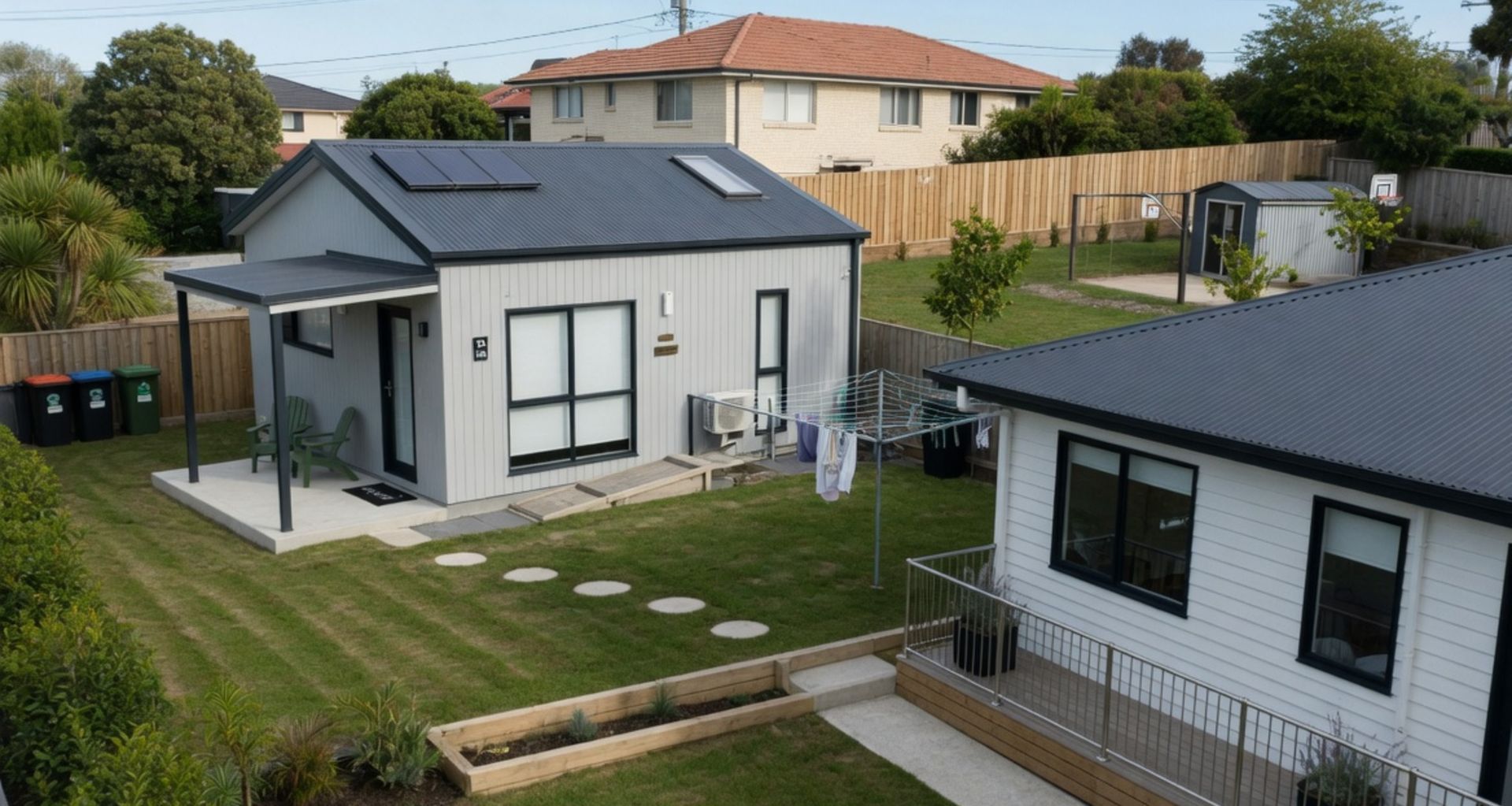
Since 15 January 2026, you can build a granny flat up to 70m² on your property without a building consent or resource consent — provided you meet the exemption conditions. It's the biggest shake-up to minor dwelling rules in decades, and Auckland homeowners are already scrambling to figure out what it means for their sections, their families, and their budgets.
We've been fielding calls about granny flats since the law change was announced. The questions are almost always the same: how much will it actually cost, what are the rules, and does my property even qualify? This guide answers all of it — from the specific exemption conditions to realistic per-square-metre pricing in Auckland, the traps people are already falling into, and how to work out whether a granny flat makes sense on your section.
What Is a Granny Flat, Exactly?
A granny flat is a self-contained secondary dwelling on your property. It's got its own kitchen, bathroom, bedroom, and living space — everything needed for independent living. Councils and legislation call them different things depending on context: "minor dwelling" in the Auckland Unitary Plan, "small standalone dwelling" under the Building Act, and "detached minor residential unit" under the new NES-DMRU planning rules. They all mean more or less the same thing.
What a granny flat is not: a sleepout. A sleepout typically lacks a kitchen and is treated as an accessory building, not a dwelling. That distinction matters because the rules — and the costs — are different. If you're adding a bedroom and bathroom without a kitchen, you're building a sleepout. If it's fully self-contained, it's a granny flat.
People build granny flats for all sorts of reasons. Housing ageing parents so they're close but independent. Giving adult kids a place to live while they save for a deposit. Generating rental income — Auckland granny flats typically rent for $400–$600 per week depending on location and spec. Or simply adding long-term value to the property.
The 2026 Consent Exemption: What Actually Changed
On 15 January 2026, two pieces of legislation kicked in simultaneously. The Building and Construction (Small Standalone Dwellings) Amendment Act removed the need for a building consent for qualifying granny flats. And the National Environmental Standards for Detached Minor Residential Units (NES-DMRU) removed the need for a resource consent — as long as you meet the permitted activity standards.
That's a significant change. Previously, building a granny flat in Auckland meant months of consenting paperwork, architectural drawings, engineering reports, council fees, and back-and-forth with planners. The government's own estimate is that the exemption saves homeowners up to $5,650 in direct consent costs and speeds up the process by up to 14 weeks.
But here's what most people get wrong: consent-free doesn't mean rules-free.
The Conditions You Must Meet
Your granny flat qualifies for the building consent exemption only if every single one of these conditions is met:
It must be a new, standalone, single-storey dwelling of 70m² or less. No loft. No mezzanine. Even a small open mezzanine counts as an additional storey and immediately disqualifies the build.
It must use lightweight steel or timber framing with lightweight roof cladding.
It must be at least 2 metres from other buildings and boundaries.
The maximum height is 4 metres.
It must not include a level-entry shower that requires a waterproof membrane. That specific detail catches people off guard — if you want a walk-in shower with no lip, you'll need a building consent.
All work must be carried out or supervised by Licensed Building Practitioners (LBPs), registered plumbers, drainlayers, gasfitters, and electrical workers.
You must apply for and receive a Project Information Memorandum (PIM) from your council before starting work.
Once the build is finished, you must notify the council and provide documentation — final plans, Records of Work from tradespeople, and certificates of compliance.
The building must comply with the Building Code in full. No waivers. No modifications.
"The exemption removes the consent process, but it doesn't remove the obligation to build properly," says Dorothy Li, Design Manager at Superior Renovations. "Every structural, insulation, and weathertightness requirement still applies. The difference is that the responsibility now sits squarely with the homeowner and their LBP — there's no council inspector checking the work along the way."
What About Resource Consent?
The NES-DMRU makes one compliant detached minor residential unit per property a permitted activity — meaning no resource consent required — in most residential and rural zones, provided the build meets the NES standards for height, setbacks, and site coverage.
But there are exceptions. If your property sits within a flood overlay, coastal hazard zone, significant ecological area, or heritage precinct, you may still need resource consent regardless of the national exemption. Properties with geotechnical constraints or outstanding natural landscape designations are also commonly affected.
In Auckland specifically, it's worth knowing that the Auckland Unitary Plan traditionally capped minor dwellings at 65m² in most residential zones. The new national building consent exemption allows up to 70m². If you're building between 65m² and 70m², you're within the building consent exemption but may still technically breach the Auckland Unitary Plan's size rule — which could trigger a resource consent requirement under local planning provisions. That gap between 65m² and 70m² is a genuine trap for Auckland homeowners, and it's the kind of detail you need professional advice on before committing.
What Does a Granny Flat Actually Cost in NZ?
This is the question everyone asks first. And the honest answer is: it depends on size, site, spec level, and location.
Per-Square-Metre Build Costs
Based on current Auckland construction pricing, here's what you're looking at for a granny flat build in 2026:
Standard spec (basic fixtures, vinyl flooring, painted GIB, laminate benchtops): approximately $2,500–$3,500 per m².
Mid-range spec (better joinery, tile flooring, stone or engineered stone benchtops, upgraded kitchen): approximately $3,500–$4,500 per m².
High-end spec (timber flooring, premium kitchen, architectural design, custom joinery): approximately $4,500–$6,000+ per m².
For a 60m² granny flat at mid-range spec, you're looking at roughly $210,000–$270,000 all-in. A full-sized 70m² build with quality finishes will typically land between $250,000 and $350,000 when you include site preparation, services connections, and professional fees.
Those numbers come from real NZ construction data. An RNZ analysis cited costs of $200,000–$300,000 for a basic 70m² granny flat, and that aligns with what we're seeing in Auckland — where costs generally sit at the higher end of the national range because tradesperson rates and material supply costs are steeper.
Where the Money Actually Goes
The build cost per square metre is only part of the picture. Here's what people consistently underestimate:
Site preparation. A flat, accessible section with existing services nearby is the dream scenario. A sloping site in Titirangi that needs retaining walls, extended drainage runs, and difficult access for machinery? That can add $20,000–$50,000 or more before a single frame goes up.
Services connections. Your granny flat needs independent connections to water, wastewater, and stormwater — either to the public network or a compliant on-site system. In Auckland, connecting to existing services typically runs $10,000–$25,000 depending on distance from the main dwelling and network capacity.
Development contributions. The consent exemption doesn't exempt you from development contributions. Auckland Council still charges these to fund infrastructure — pipes, roads, community assets. They're identified during the PIM process and can add thousands to the total cost.
Professional fees. Even without a building consent, you'll need an LBP, likely a designer or drafter for plans, and potentially a geotechnical engineer depending on your site. Budget $10,000–$20,000 for professional services.
What the exemption actually saves you: roughly $5,000–$15,000 in direct consent fees, consultant reports, and processing costs, plus 6–14 weeks of time. Real money. But not a game-changer on a $250,000+ project.
Prefab vs. Site-Built: A Real Comparison
Prefab granny flats have become hugely popular since the law change. Companies are advertising transportable units from around $120,000–$180,000 for a basic cabin-style build. That sounds appealing — until you factor in what's not included.
Most prefab quotes exclude site works, foundations, services connections, council PIM fees, development contributions, and consenting costs if your site doesn't meet the exemption criteria. Once you add those in, the gap between prefab and site-built narrows significantly.
Site-built granny flats give you more control over design, layout, and material quality. They can be tailored to your section's orientation — capturing northern sun, working with the slope, complementing your existing home. A client of ours in Henderson recently explored both options for their 55m² granny flat and found the total project cost was within $15,000 either way, once site works and connections were included. The site-built option gave them exactly the layout they wanted.
Eunice Qin, one of our designers, puts it simply: "Prefab works well if your section is flat, accessible, and close to services. If it's not — and a lot of Auckland sections aren't — you end up spending just as much adapting the prefab to your site as you would designing something purpose-built."
Does Your Auckland Property Qualify?
Not every section is suited to a granny flat. Before you get excited about the exemption, here's the reality check.
Section Size and Zoning
In most Auckland residential zones, you can have one minor dwelling per site. The Auckland Unitary Plan's Single House Zone — which covers huge swathes of suburbs like Remuera, Epsom, Mt Eden, and parts of the North Shore — allows one minor dwelling as a permitted activity, provided it's under 65m² and meets all zone standards for setbacks, height, and site coverage.
Mixed Housing Suburban zones (common in areas like Henderson, Massey, and parts of Hillsborough) and Mixed Housing Urban zones are more flexible — they allow up to three dwellings per site in some cases, which can make the granny flat pathway even simpler.
The minimum section size isn't nationally prescribed, but practically speaking, you need enough space for the granny flat itself, the 2-metre boundary setbacks, outdoor living space, and usually a car park. Most planners suggest a minimum of around 500m² for a comfortable granny flat build.
The Overlays That Can Block You
Auckland has extensive overlay maps that can override the national exemption. Properties in the following areas often face extra hurdles:
Flood plains and overland flow paths — common across South Auckland, parts of the North Shore, and low-lying areas near streams. If your section is mapped in a flood overlay, expect additional engineering and potentially a resource consent.
Coastal hazard zones — properties in suburbs like St Heliers, Glendowie, West Harbour, and parts of the Hibiscus Coast may be subject to coastal inundation or erosion overlays.
Heritage and special character zones — Grey Lynn, Ponsonby, Devonport, and Birkenhead have extensive character overlays that can restrict what you build and where.
Significant ecological areas — sections backing onto bush reserves or wetlands in suburbs like Titirangi, Swanmore, and parts of Albany.
Check Auckland Council's GeoMaps tool online — it'll show you every overlay affecting your property. Or, better yet, get a professional to review it before you spend money on plans.
The PIM Process: What to Expect in Auckland
Even without a building consent, you must apply for a Project Information Memorandum before you start building. The PIM tells you what your council knows about your site — flood risks, contamination history, infrastructure capacity, relevant overlays, and any other factors that could affect your build.
Auckland Council uses the PIM process to also calculate and charge development contributions. These vary by location but can be significant — potentially $15,000–$30,000+ for a new dwelling unit, depending on your area's infrastructure needs.
The PIM application itself isn't complicated, but it does take time. Budget 2–4 weeks for processing, though Auckland Council turnaround times fluctuate.
Granny Flats as an Investment: Do the Numbers Stack Up?
The investment angle is what's driving most of the interest — and the maths is worth examining honestly.
A granny flat in a decent Auckland suburb can rent for $400–$600 per week. At $500 per week, that's $26,000 per year in gross rental income. If you've borrowed $250,000 at current interest rates to fund the build, your mortgage repayments will be roughly $400–$480 per week (depending on your rate and term). That's a thin margin before you account for maintenance, insurance, rates adjustments, and vacancy periods.
The equity play is more compelling. A well-built granny flat generally adds roughly its construction cost to the property value — sometimes more in desirable suburbs. You're not going to double your money, but you're not losing it either. And if the flat is earning rent in the meantime, the effective return improves.
One thing to be clear about: if you're planning to rent your granny flat out, it must comply with the Residential Tenancies Act and the Healthy Homes Standards. That means minimum heating, insulation, ventilation, moisture, and draught-stopping standards must be met. The consent exemption doesn't reduce your obligations as a landlord.
We work with homeowners across Auckland who are thinking about granny flats as part of a broader property strategy — whether it's a house extension to the main dwelling combined with a granny flat, or a full home renovation that incorporates a new minor dwelling on the section. If you're weighing up options, our house extension cost calculator can help you compare the relative costs.
For projects involving structural design, consent strategy, or complex sites, our group architectural practice Sonder Architecture works alongside our build team to handle the full design-to-build pipeline — particularly useful where the exemption conditions don't quite apply and a consented pathway is needed.
Common Mistakes We're Already Seeing
The exemption has been live for less than three months, and we're already seeing homeowners trip up. Here are the big ones:
Assuming consent-free means anything goes. The exemption has strict conditions. Miss one — a level-entry shower, a mezzanine, the wrong cladding type — and you're back in the full consent process. Worse, if you've already started building without consent when you should have had one, you're looking at a potential $300,000 fine under the Building Act.
Ignoring the 65m² vs 70m² gap in Auckland. The national exemption says 70m². The Auckland Unitary Plan says 65m² for minor dwellings in many zones. If you build a 68m² granny flat thinking you're covered, you might be exempt from building consent but still need resource consent under the Unitary Plan. Get this checked before you commit to a floor plan.
Underestimating site costs. We've had homeowners in suburbs like Titirangi and West Harbour get quotes for the build itself, then discover that site preparation doubles the budget. Auckland's terrain is wildly varied — a 10-minute drive can take you from flat reclaimed land to steep clay hillsides.
Skipping the PIM. Some homeowners hear "no consent needed" and assume they can just start building. You cannot. The PIM is mandatory. Building without one is non-compliant and exposes you to enforcement action.
Not checking title restrictions. Your Record of Title may contain covenants, easements, or consent notices that restrict what you can build — regardless of what the national exemption allows. Cross-lease properties are a particularly common complication: you'll need the other lessees' consent and an updated flats plan before you can add a granny flat.
Frequently Asked Questions
How much does it cost to build a granny flat in NZ?
Expect $2,500–$5,000 per square metre depending on spec level, plus $20,000–$50,000+ for site preparation, services, and professional fees. A mid-range 60m² granny flat in Auckland typically costs $210,000–$270,000 all-in. A full-sized 70m² build with quality finishes can reach $250,000–$350,000.
Do I need building consent for a granny flat in 2026?
Not if your granny flat meets every condition of the exemption that came into force on 15 January 2026. It must be a new, standalone, single-storey dwelling under 70m² with lightweight framing, built or supervised by LBPs, at least 2m from boundaries, and with no level-entry shower requiring a waterproof membrane. If you miss any condition, a building consent is required.
Do I still need resource consent for a granny flat in Auckland?
The NES-DMRU allows one compliant minor dwelling per property without resource consent in most residential zones. But if your property has overlays (flood, heritage, coastal hazard, ecological) or your build exceeds local zone standards, resource consent may still be needed. The 65m² cap in many Auckland zones is a particular watch-out.
Can I build a two-storey granny flat without consent?
No. The exemption applies only to single-storey dwellings. Any form of second storey, loft, or mezzanine — even an open one — disqualifies the build from the exemption. You'd need a full building consent.
Can I rent out a consent-free granny flat?
Yes. A granny flat built under the exemption can be rented out, but it must comply with the Residential Tenancies Act and Healthy Homes Standards. The consent exemption doesn't change your obligations as a landlord.
What is a PIM and do I need one?
A Project Information Memorandum is a report from your council about your site — hazards, overlays, infrastructure, and any other relevant information. You must apply for and receive a PIM before starting any granny flat build under the exemption. Auckland Council uses the PIM process to also calculate development contributions.
How long does it take to build a granny flat?
A straightforward site-built granny flat in Auckland typically takes 12–20 weeks from site preparation to handover, depending on complexity and weather. Prefab options can be faster — sometimes 8–12 weeks from delivery — but site works and connections still take time. The exemption removes 6–14 weeks from the old consenting timeline.
Whether you're thinking about a granny flat, a full extension, or you just want to understand what's possible on your section, we're here to help. Visit our showroom at 16B Link Drive, Wairau Valley, or book a free consultation to talk through your options with our design team. We'll give you a straight answer on costs, timelines, and whether the exemption pathway works for your property.